
How to Mix Two-Stroke Fuel: Ratios, Chart and Common Mistakes
At 50:1 you add 20 ml of oil per litre of petrol, or 100 ml to a 5-litre can. Here is what the ratios mean, which one your chainsaw, trimmer, dirt bike or outboard needs, how to mix it properly, and which oil to use.
Short answer: to mix two-stroke fuel, divide the amount of fuel in millilitres by the ratio. At 50:1, the most common ratio for modern chainsaws, trimmers and leaf blowers, that is 20 ml of oil per litre of petrol, or 100 ml for a 5-litre can. At 40:1 it is 25 ml per litre, and at 32:1 about 31 ml. Always use the ratio in your equipment manual, and mix only as much as you will use within a month.
Getting the mix right is the cheapest insurance a two-stroke engine has. Too little oil and the piston can score or seize; too much and you get smoke, fouled plugs and carbon. This guide explains what the ratios mean, which ratio your equipment needs, how to mix it properly, and which oil to use. To skip the maths, use our free two-stroke oil mix calculator: enter the ratio and the amount of fuel, and it tells you exactly how much oil to add.
What does a mix ratio like 50:1 mean?
The ratio is parts of fuel to one part of oil. 50:1 means 50 parts petrol to 1 part two-stroke oil. Because a litre is 1,000 ml, the formula is simple:
Oil (ml) = fuel (litres) × 1,000 ÷ ratio
So 5 litres at 50:1 is 5 × 1,000 ÷ 50 = 100 ml of oil. The lower the second number gets relative to the first (for example 32:1 compared with 50:1), the more oil goes into the mix. That is the most common source of confusion: 32:1 is a richer, oilier mix than 50:1, not a leaner one.
Two-stroke mix chart
Millilitres of two-stroke oil to add for common fuel amounts:
| Fuel | 100:1 | 50:1 | 40:1 | 32:1 | 25:1 |
|---|---|---|---|---|---|
| 1 L | 10 ml | 20 ml | 25 ml | 31.2 ml | 40 ml |
| 5 L | 50 ml | 100 ml | 125 ml | 156.2 ml | 200 ml |
| 10 L | 100 ml | 200 ml | 250 ml | 312.5 ml | 400 ml |
| 20 L | 200 ml | 400 ml | 500 ml | 625 ml | 800 ml |
Need a different amount, or know how much oil you have and want to know how much fuel to add? The mix calculator works both ways and accepts any ratio from 20:1 to 100:1.
Which ratio does my equipment need?
| Equipment | Typical ratio | Notes |
|---|---|---|
| Modern chainsaws, trimmers, brush cutters, leaf blowers | 50:1 | STIHL, Husqvarna, ECHO and most current handheld tools. |
| Older garden tools and older chainsaws | 25:1–40:1 | Common on equipment from the 1990s and earlier. Check the fuel cap or manual. |
| Premix mopeds and scooters | 50:1 | Many scooters have oil injection instead – then you do not premix at all. |
| Two-stroke dirt bikes and enduro | 32:1–60:1 | Varies by make and model year. Racing use often runs richer. |
| Premix outboard motors | 50:1 | Some allow 100:1. Outboards need an oil rated NMMA TC-W3. |
These are typical values, not a replacement for your manual. The ratio printed on the fuel cap, in the manual or on the engine always wins. If you own several machines with different ratios, label each fuel can clearly.
Not sure whether your engine needs premix? If it has a separate oil tank, it has oil injection and runs on plain petrol. Four-stroke engines, which have their own oil sump and a dipstick, never take premix.
How to mix two-stroke fuel step by step
- Use a clean, approved fuel can with volume markings, and a measuring cup or a bottle with millilitre marks for the oil.
- Use fresh petrol of the octane your manual specifies. Fuel that has stood for months has already started to break down.
- Work out the oil amount with the chart above or the calculator.
- Pour in about half the fuel, then add the full amount of oil.
- Close the can and shake it well, then add the rest of the fuel and shake again.
- Label the can with the ratio and the date.
- Shake again before each refill if the can has been standing.
Never mix oil directly in the equipment's tank. The oil will not blend evenly, and the first minutes of running can be on almost neat petrol.
Choosing the right two-stroke oil
The ratio is only half the story; the oil has to be made for the engine. Look for the rating your manual asks for.
Chainsaws, trimmers and other handheld tools
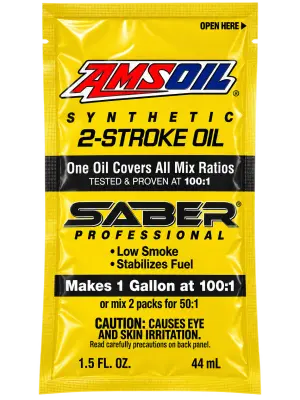
Handheld equipment calls for an oil rated JASO FD, ISO-L-EGD or API TC. AMSOIL SABER Professional Synthetic 2-Stroke Oil meets these and works in STIHL, Husqvarna, ECHO and other two-stroke tools, including STIHL 4-Mix engines. Its synthetic base oils burn cleanly, which helps prevent stuck rings, clogged exhaust ports and plugged spark arrestor screens, and it also helps stabilise the fuel during storage.
SABER is sold in pre-measured bottles, which makes mixing easy. Switch the calculator to I know the oil amount to see how far a bottle goes: the 103.5 ml bottle mixes about 5.2 litres at 50:1, and the 44.4 ml bottle about 2.2 litres at 50:1. SABER is formulated for ratios up to 100:1, but run it at 100:1 only if your equipment manufacturer allows that ratio.
Dirt bikes, karts and high-revving engines
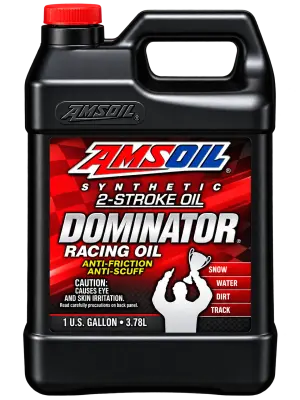
Competition engines rev high and run hot. AMSOIL DOMINATOR Synthetic 2-Stroke Racing Oil uses higher-viscosity synthetic base oils and anti-friction chemistry to protect against piston scuffing and bearing wear in engines that can exceed 10,000 rpm. It burns clean, helps prevent ring sticking and plug fouling, and is suitable for engines with exhaust power valves. Mix it at the ratio your bike's manual specifies.
Riding a four-stroke bike as well? Our guide on how often to change motorcycle oil covers four-stroke intervals.
Outboard motors
Water-cooled outboards run cooler than air-cooled engines and need an oil rated NMMA TC-W3. Do not use an air-cooled handheld oil in an outboard. Contact us and we will help you find the right oil for your boat.
Common mixing mistakes
- Adding "a bit extra for safety". More oil does not mean more protection. It means more smoke, fouled spark plugs and carbon on the piston and exhaust port.
- Mixing up the ratios. 32:1 contains more oil than 50:1. Running a 32:1 engine on 50:1 fuel starves it of lubrication.
- Using car or four-stroke oil. It is not made to burn with the fuel and leaves heavy deposits. Use only oil labelled for two-stroke engines.
- Following US instructions in ounces. "2.6 oz per gallon" refers to US gallons. Work in litres and millilitres, or use the calculator.
- Using old mixed fuel. Premix older than about a month makes starting harder and can leave gum in the carburettor.
- Guessing the amount of fuel. Fill the can to a marked line before adding oil, rather than mixing into a can that is partly full.
Keeping mixed fuel fresh, and winter storage
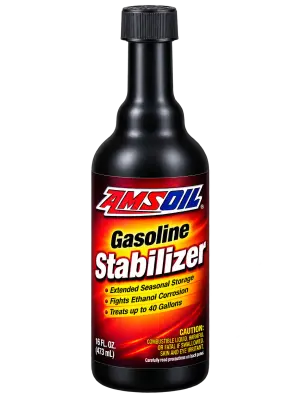
Petrol starts to age within weeks, and the ethanol in modern E5 and E10 petrol attracts moisture. Mixed fuel is best used within about a month. If you buy fuel in larger amounts, or your equipment is used only now and then, add AMSOIL Gasoline Stabilizer when you fill the can. It keeps fuel fresh for up to 12 months and protects against varnish, gum and ethanol corrosion.
Before your trimmer, blower or outboard goes away for the winter, follow the storage instructions in the manual. Many manufacturers recommend emptying the tank and running the engine until it stops, so no fuel is left to go stale in the carburettor. If you leave fuel in the system, make sure it is fresh and treated with stabiliser, and run the engine for a few minutes so the treated fuel reaches the carburettor.
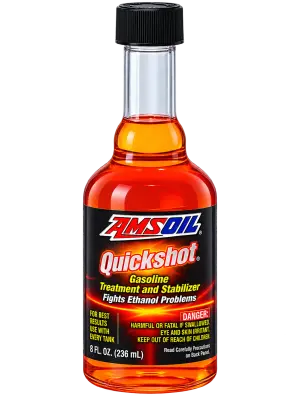
If a machine already starts badly or idles roughly after storage, gum in the carburettor is a common cause. AMSOIL QuickShot cleans varnish and gum from carburettors and fuel systems in two- and four-stroke engines, helps prevent ethanol from separating from the petrol, and can be added with every tank.
Frequently asked questions
How much oil do I add to 5 litres of petrol?
100 ml at 50:1, 125 ml at 40:1, about 156 ml at 32:1, and 200 ml at 25:1.
Can I use 50:1 fuel in an engine that needs 40:1?
It is better not to. 50:1 contains less oil than 40:1, so the engine gets less lubrication than it was designed for. Mix a separate can at the correct ratio.
Is it OK to run a richer mix than the manual says?
A slightly richer mix will not usually cause damage, but it brings more smoke, carbon and fouled plugs without extra protection. Some manufacturers specify a richer mix for running in a new engine; follow the manual on that.
Can I mix different brands of two-stroke oil?
Most two-stroke oils are compatible, but you lose the benefits of the better oil. For the cleanest running, stick to one oil and the same ratio.
Do oil-injected engines need premix?
No. They take oil from a separate tank and meter it automatically, so you fill up with plain petrol and keep the oil tank topped up.
The bottom line
Use the ratio in your manual, measure in millilitres, and mix fresh fuel in a clean can: half the fuel, all the oil, shake, then the rest. For most modern handheld tools, that is 20 ml of oil per litre at 50:1. Our two-stroke mix calculator does the maths for any ratio and amount.
See SABER Professional for garden and forestry tools, DOMINATOR 2-Stroke for racing engines, and our fuel additives for storage. Contact us if you are unsure which oil or ratio is right. Pickup is available in Riga, with delivery across Latvia, Estonia and Lithuania.