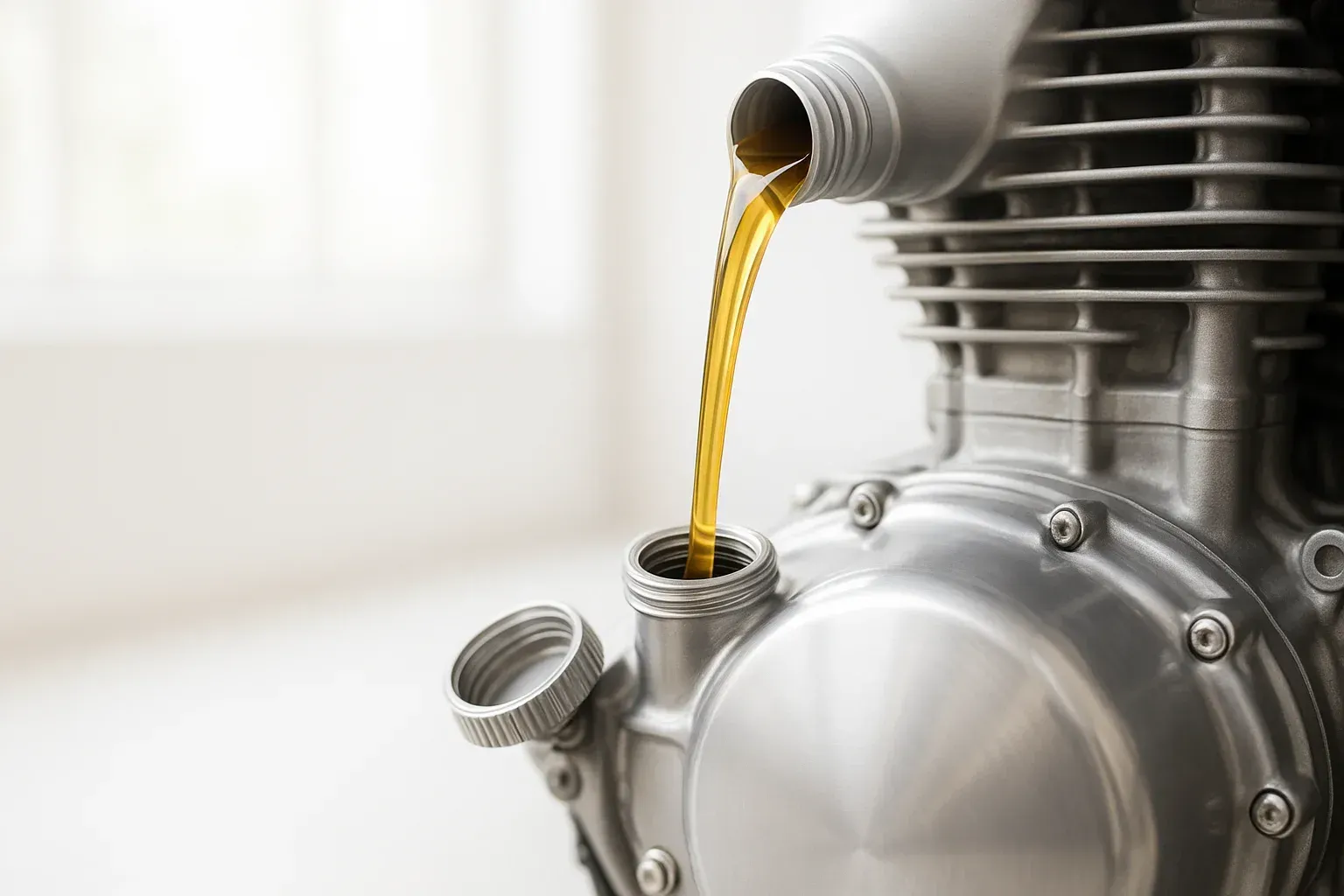
How Often Should You Change Your Motorcycle Oil?
Every 5,000–10,000 km or once a season for most street bikes, and always before winter storage. Sport bikes, air-cooled engines, scooters and dirt bikes need it sooner. Here is how to find the right interval for your bike.
Short answer: most modern street motorcycles need an oil change every 5,000–10,000 km or once a season, whichever comes first. Sport bikes ridden hard, air-cooled engines and small scooters sit at the shorter end. Four-stroke dirt bikes are measured in riding hours, not kilometres. Whatever you ride, change the oil before the bike goes into winter storage.
Motorcycle oil has a harder job than car oil, so it needs changing more often. This guide explains why, gives typical intervals for each type of bike, and shows how to find the right one for yours.
Why motorcycles need more frequent oil changes than cars
In a car, the engine oil only lubricates the engine. In most motorcycles, the same oil also lubricates the gearbox and the wet clutch. Gear teeth shear the oil's molecules apart, and the clutch sheds friction material into it. On top of that, motorcycle engines rev much higher than car engines, often hold less oil, and many are air-cooled, so they run hotter. All of this wears the oil out faster.
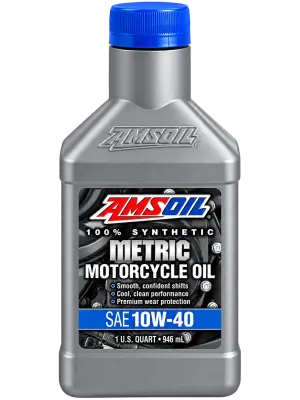
That is also why car oil is the wrong choice for most motorcycles. Many car oils contain friction modifiers that make a wet clutch slip. Look for the JASO MA or MA2 rating on the bottle, which confirms the oil is safe for wet clutches. Purpose-built oils such as AMSOIL 10W-40 Synthetic Metric Motorcycle Oil are formulated for this combined engine, gearbox and clutch job.
Driving a car as well? Our guide on how often to change the oil in your car covers car intervals.
Motorcycle oil change intervals at a glance
| Type of bike | Typical interval | Notes |
|---|---|---|
| Modern street bike, liquid-cooled | 6,000–10,000 km or once a season | Follow the service manual. Change the filter every time. |
| Sport bike ridden hard, or with track days | 4,000–6,000 km | High revs shear the oil faster. |
| Air-cooled bike or classic | 3,000–5,000 km | Runs hotter and often has no oil filter on older models. |
| V-twin cruiser | 5,000–8,000 km | Many have separate engine, primary and transmission oils. |
| Scooter (4-stroke) | 3,000–5,000 km | Small sump and high revs. |
| 4-stroke dirt bike / MX | Every 10–15 riding hours | Every 1–3 race days when racing. |
These are general ranges, not a replacement for your owner's manual. If the manual specifies a shorter interval, use that one.
Intervals by type of bike
Street and sport bikes
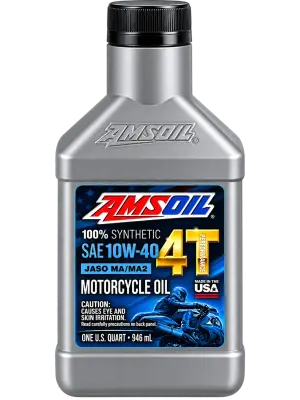
Most liquid-cooled Japanese and European bikes list 6,000–10,000 km between changes, with the filter changed every time. If you regularly ride near the red line, carry a passenger, or do track days, use the lower figure. Most of these bikes use a 10W-40 or 10W-30 with a JASO MA2 rating. For high-revving sport bikes, see AMSOIL 4T Performance 10W-40.
V-twin cruisers
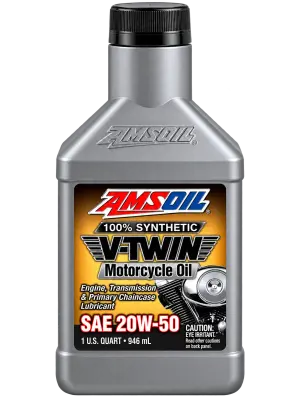
Many large V-twins, Harley-Davidson in particular, use three separate fluids: engine oil, primary chaincase fluid and transmission fluid. Each has its own interval in the service manual, and each needs the right product. AMSOIL 20W-50 Synthetic V-Twin Motorcycle Oil covers the engine. The V-Twin Oil Change Kit has everything for the engine service, and the V-Twin Primary Fluid and V-Twin Transmission Fluid cover the rest.
Air-cooled and classic bikes
Air-cooled engines run hotter than liquid-cooled ones and depend more on the oil to carry heat away. Older bikes may also have only a mesh screen instead of a proper oil filter. Change the oil more often, every 3,000–5,000 km. A thicker grade such as AMSOIL 15W-50 Synthetic Metric Motorcycle Oil is often specified for hot-running engines.
Scooters
A small 4-stroke scooter engine holds less than a litre of oil and spends most of its life at high revs. Short city trips add condensation on top of that. Change the oil every 3,000–5,000 km, and at least once a year, with an oil made for the job, such as AMSOIL Formula 4-Stroke Synthetic Scooter Oil.
Dirt bikes and enduro
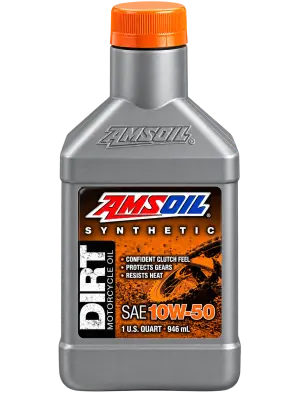
Off-road bikes are serviced by riding hours, not kilometres. Most 4-stroke motocross bikes need fresh oil every 10–15 hours, and racers often change it after every race day. Many modern dirt bikes have separate engine and gearbox compartments, so check which oil goes where. Use a dedicated oil such as AMSOIL 10W-50 Synthetic Dirt Bike Oil, and Dirt Bike Transmission Fluid for a separate gearbox.
Riding season and winter storage
In the Baltics, most bikes are ridden for six or seven months and stored for the rest. That makes the time limit as important as the distance. Many riders cover only 3,000–5,000 km a season, so the oil never reaches its kilometre limit, but it still ages.
The best time to change the oil is before the bike goes into storage, not in spring. Used oil contains acids, fuel and moisture from combustion, and over several months in a cold garage these attack bearings and seals. Store the bike with fresh oil, add a fuel stabiliser to a full tank, and run the engine for a few minutes so the treated fuel reaches the fuel system. In spring, check the level and ride.
Signs your motorcycle oil change is overdue
- Gear changes feel notchy or stiff, especially when the engine is warm. Sheared oil protects the gearbox less.
- The clutch slips under acceleration. It can also mean the wrong oil.
- The oil looks dark or gritty in the sight glass or on the dipstick, or the level keeps dropping.
- The engine sounds louder or more mechanical than usual.
- The last change was over a season ago, whatever the distance.
Tips for a proper motorcycle oil change
- Check the level the way the manual says. Some bikes are checked upright on the centre stand, others on the side stand, and some with the engine warm. Doing it the wrong way gives a wrong reading.
- Change the filter every time. It is cheap and holds the dirt the oil has collected.
- Use a new crush washer on the drain plug and tighten it to the specified torque.
- Use a JASO MA/MA2 oil in the viscosity your manual lists.
- Look after the chain at the same time. Clean and lubricate it with a chain lube while the bike is on the stand.
Frequently asked questions
Can I use car oil in my motorcycle?
Not if your bike has a wet clutch, which most do. Many car oils contain friction modifiers that can make the clutch slip. Use an oil rated JASO MA or MA2. Bikes with a dry clutch, or a separate gearbox, are less sensitive, but a motorcycle oil is still the safer choice.
Does synthetic oil let me go longer between changes?
Synthetic oil resists heat and shear much better, so it protects the engine and gearbox better throughout the interval. On a motorcycle, use that as extra protection rather than a reason to stretch the interval past what the manual allows.
How often should I change the oil if I only ride a little?
At least once a year, ideally before winter storage, even if you rode only a few hundred kilometres. Oil ages with time, not only with distance.
Do I need to change the oil filter every time?
Yes, on almost every modern bike. A few manuals allow every second change, but a new filter is cheap insurance for a much more expensive engine.
The bottom line
For most street motorcycles, plan an oil change every 5,000–10,000 km or once a season, and always before winter storage. Change it sooner for hard riding, air-cooled engines and scooters, and go by riding hours on a dirt bike. Use an oil rated for wet clutches, and change the filter every time.
Browse all motorcycle oils and fluids, or contact us and we'll help you choose the right oil for your bike. Pickup is available in Riga, with delivery across Latvia, Estonia and Lithuania.