
Winter oil guide
Winter Oil Viscosity Guide
What do 0W and 5W actually mean when it’s −25 °C in Riga? Pick your oil grade and the outside temperature to see how it handles a cold start, based on the SAE J300 standard.
- Within cold rating
- Hard cranking
- Below pumping limit
AMSOIL 5W-30 in our shop
Car & Truck
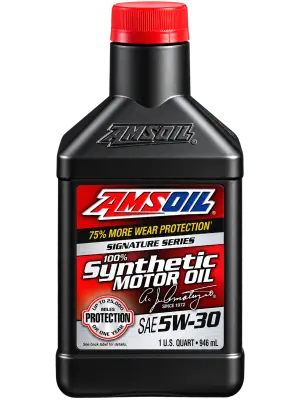
AMSOIL Signature Series 5W-30 100% Synthetic Motor Oil
Engineered for enthusiasts seeking maximum protection and performance. Precision-formulated with cutting-edge technology and a longstanding devotion to making the world’s best motor oil. The result: engine protection that blows the doors o…
€17.48
In stock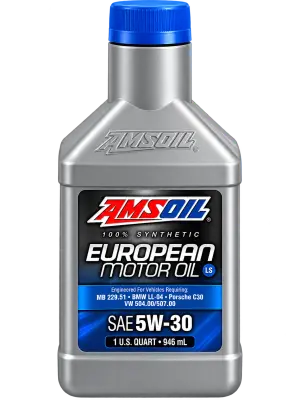
Car & Truck
AMSOIL 5W-30 LS 100% Synthetic European Motor Oil
ADVANCED ENGINE PROTECTION Delivers 100% synthetic engine protection for advanced automotive technology. Thermally stable oil formulation resists deposit formation and cools turbochargers . Formulated for long drain intervals recommended b…
€17.39
In stock
How to read an oil grade
A multigrade oil such as 5W-30 has two ratings from the SAE J300 standard: one for cold starts and one for hot running.
The first number: cold starts
The W stands for winter. The lower the number, the colder the temperature at which the oil still lets the engine crank and the oil pump draw oil. Each step of 5 moves the limit about 5 °C colder.
| Grade | Cranking test | Pumping test |
|---|---|---|
| 0W | -35 °C | -40 °C |
| 5W | -30 °C | -35 °C |
| 10W | -25 °C | -30 °C |
| 15W | -20 °C | -25 °C |
| 20W | -15 °C | -20 °C |
| 25W | -10 °C | -15 °C |
The second number: hot running
The second number describes viscosity at normal operating temperature (100 °C) and under high shear (150 °C). Once the engine is warm, a 0W-30 and a 5W-30 meet the same requirements.
| Grade | Viscosity at 100 °C | Min. HTHS at 150 °C |
|---|---|---|
| 16 | 6.1–8.2 mm²/s | 2.3 mPa·s |
| 20 | 6.9–9.3 mm²/s | 2.6 mPa·s |
| 30 | 9.3–12.5 mm²/s | 2.9 mPa·s |
| 40 | 12.5–16.3 mm²/s | 3.5 mPa·s |
| 50 | 16.3–21.9 mm²/s | 3.7 mPa·s |
| 60 | 21.9–26.1 mm²/s | 3.7 mPa·s |
Source: SAE J300. For 15W-40 and heavier 40 grades, the minimum HTHS is 3.7 mPa·s.
0W-20 or 5W-40?
These two grades come up most often, and they are built for different engines. The right one is whichever your owner’s manual or the manufacturer approval specifies.
0W-20
- Specified for many newer petrol engines and hybrids, including engines that require VW 508 00, MB 229.71 or Volvo RBS0-2AE.
- Flows fastest at a cold start, which helps on short winter trips.
- Thinner when hot, which cuts friction and fuel use in engines designed for it.
5W-40
- Common in older and performance European petrol engines and diesels, with approvals such as VW 502 00/505 00, MB 229.5, BMW Longlife-01 or Porsche A40.
- Thicker when hot, for engines built around a stronger oil film under heat and load.
- Still rated for cranking down to −30 °C, which covers most Baltic winters.
Don’t switch to a thinner hot grade than your engine specifies. If your manual allows several grades, choosing a lower W number is a safe way to improve winter starts.
Frequently asked questions
What does the W in 5W-30 mean?
W stands for winter. The number before it shows how well the oil handles cold starts: under SAE J300, a 5W oil is tested for cranking at −30 °C and for pumping at −35 °C.
Is 0W better than 5W in a Baltic winter?
A 0W oil is rated 5 °C colder than a 5W, so it reaches the bearings faster on very cold mornings. At typical winter temperatures, both are well within their ratings. Where your manual allows either, 0W gives extra margin for cold snaps.
Is a 0W oil too thin when the engine is hot?
No. The hot viscosity is set by the second number. A 0W-40 and a 5W-40 must meet the same requirements at 100 °C and 150 °C.
Can I use 0W-30 instead of 5W-30?
Usually yes, if the 0W-30 carries the same manufacturer approvals your engine requires. The hot grade is the same, and the 0W only improves cold flow. Always check the approval codes, not just the grade.
Do I need to change to winter oil in autumn?
No. Modern multigrade oils are year-round. Choose a grade that covers your coldest mornings and stick to your service interval. Only change early if your oil’s W grade is too high for the cold you expect.
What oil should I use at −30 °C?
Choose a 0W or 5W oil that meets your manufacturer’s specification. Below about −30 °C even well-chosen oils thicken considerably, so an engine block heater is the most effective way to protect the engine and battery.